|
|
|
|
|
Courtesy Herbert Aptheker and University of Massachusetts Press, respectively editor and publisher of Against Racism, a collection of unpublished speeches and papers by Du Bois, in which the following speech appears on pages 173-184. |
|
|
|
|
|
Courtesy Herbert Aptheker and University of Massachusetts Press, respectively editor and publisher of Against Racism, a collection of unpublished speeches and papers by Du Bois, in which the following speech appears on pages 173-184. |
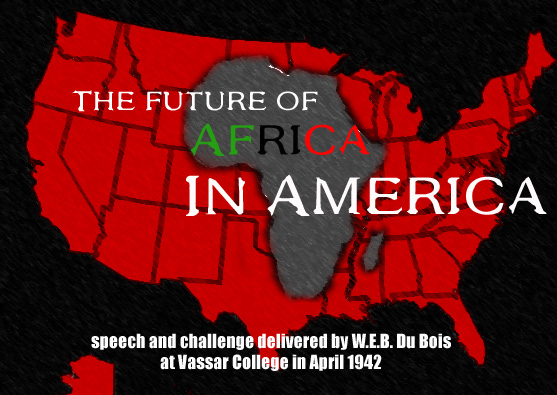
While Du Bois was head of the Sociology
Department at Atlanta University and editor of Phylon, he was invited to speak
at Vassar College. The text of his lecture follows here.
Of
the social problems that must be faced anew, reconsidered and restated there is
none of greater importance than that of the presence on the American continent
of thirty millions of persons of Negro descent. Of these perhaps fifteen million
have no visible intermixture of white blood, while the rest are of mixed
European, Negro and American Indian descent. There are many other millions,
perhaps thirty, who are in fact of Negro descent but with so large an
infiltration of white blood that the Negro blood is not in evidence and
sometimes quite unknown.
Two considerations set this body of American
immigrants apart: their visibility, – the fact that more easily than in the
case of any other body of immigrants they can be recognized; and secondly, and
closely aligned with the fact that the overwhelming majority were forcibly
transported as chattel slaves and consequently are only a generation or two
removed from the lowest social status. The union of color and status, therefore,
has fixed in the minds of men a psychological reaction which must be taken into
account. One could hardly be born in America, North or South, and not
subconsciously regard color and low social status as inevitably connected. But
there would be a difference in rationalizing this fact; in the United States
color would [be] assume[d] to be the cause of the status of blacks; while in
South America status would include Negroes and Indians for social and historical
causes. In the West lndies white descent largely determines status while caste
applies usually to unmixed Negro blood.
It has been the fashion in practically every American
nation to attempt to ignore the Negro-American as a problem. Even when this
population affects other social problems, the situation is often considered and
treated as though the Negro element were not there and did not greatly modify
the conditions of the problem. For instance many books on immigration to the
United States ignore entirely the Negro immigrant. When foreign immigrants are
considered often the Negro is regarded neither as an immigrant nor as a native
American. (Compare [Louis] Adamic's Two Way Passage.) When restriction of
immigration into the United States was debated between 19i7 and i927, the basis
gradually was changed from the proportion of the foreign born of different
origin to consideration of the original racial stocks as the standard for future
incomers. But at the beginning of the Nineteenth Century, 19 per cent of the
inhabitants of America were of Negro descent. It took some adroit wording of the
law and administration of its provisions to avoid this uncomfortable fact, but
it was avoided. Visitors to the West Indies, especially if they are from the
United States, are surprised and intrigued at the fact that the \Vest Indies are
predominantly Negroid, but they say little about it. Thereafter they leave the
West Indies out of their consideration of democracy and equality; of general
progress and development; without the openly stated reason, but with the reserve
judgment that such development is either impossible or undesirable in a land of
Negroes. Thus the West Indies and Central America tend to become a sort of
international slum to be exploited by foreign capital and tourists.
On the other hand, it is increasingly evident that we
must in the future give more notice to this element among the nations of the
Americas. When after this Second World War we come to consider the pressing
social problems before us, the Negro is going to be an element in this problem,
not simply because of his actual social condition, but because of the
psychological reaction of his fellow citizens toward him. In the matter of
poverty, for instance, which we are going to face after the war, not as an
inevitable curse, but as something which will yield to remedial measures, we
will have to remember and take account of the past. We will recall that the
plight of labor in South America and the West Indies, makes poverty a pressing
and immediate problem and that the condition of labor there finds its greatest
and most convincing excuse in the fact that the labor of these countries is
largely Negro and Indian. That Negroes and Indians will always be poor is
accepted as both probable and bearable and the only solution will lie in their
becoming white by absorption and white immigration. Until that time, former
philosophy has assumed that poverty, disease and inefficiency must characterize
the laboring class. Imported capital will thrive on low wage and servile
conditions, while labor laws and unions will be few. In the same way in the
United States the whole labor movement, especially in its attempt to fight
poverty by unionization, has long been faced and frustrated by the fact that
perhaps an eighth of that labor is of Negro descent and unless unionized, can be
and has been widely used to break down the living standards and keep down wages
of white labor. Skilled labor enclaves, like the locomotive engineers and the
machinists, have maintained a purely racial exclusion from these unions; but
where mass production has superseded special skills, the Negro worker competes
as in the automobile industry. On the other hand, white labor because of
inherited cultural patterns and surrounding public opinion is unwilling to
recognize Negro laborers as fellow human beings. Often this resentment flares in
riot and mob rule.
Out
of this situation arise, as children of poverty', disease and crime: a
widespread incidence of communicable and dangerous disease, a great loss of time
through sickness, and the death of millions of people in the prime of life. And
also a great amount of crime evidenced, as crime always is, among the young, by
stealing and fighting and low sex mores; and leading to bitter reprisals and
large expense of police and courts; and to the continuous manufacture of a
distinct criminal element not only in Harlem but over the land.
What now is going to be said of a frontal attack
on poverty after this war if this attack is to include not only the Southern
United States and the Negro slums of New York and Chicago, but also Cuba, Puerto
Rico, Honduras and Bahia? Will not the ready reply be: Impossible!
Inconceivable! and would not the cost include dearer sugar and cocoa and a lower
return on investment? Finally, there would be the one unanswerable reason
against any action: Race. The alternative would be to arrack poverty among white
workers only' but this cannot be done in America today.
Stepping beyond this, we face even greater
post-war difficulty, when we come to the problem of applying something of what
we have been newly preaching and even screaming about democracy, after two wars
to defend democracy have been fought. Long before these wars, there was the
deliberate exclusion of the great majority of Negroes from political rights by
reason of poverty and ignorance, in the West Indies and South America; the
attempt to realize anything that could really be called democracy involves
equality; equality of status based at least on approach to equality of income.
So far as Negroes are not regarded as equals, there can be no real conception of
a democracy which includes them. In the United States most Negroes have been
disfranchised no matter what their social and intellectual status might be.
Click
Here to join the discussion